
The Expert Guide to Retail Allocation and Replenishment
Boost your inventory productivity by understanding allocation and replenishment best practices, common challenges, and innovations.
As retailers must react to the increasingly complex ways consumers want to engage, the focus on inventory productivity continues to intensify. Changes in how fulfillment activities integrate with the supply chain and the downstream impact on customer experience define new considerations for developing and enhancing retail allocation and replenishment strategies.
In this expert guide, Parker Avery team members take a deep dive into some of the key components related to retail allocation and replenishment processes. We cover the end-to-end retail allocation and replenishment business processes, essential capabilities and best practices required for success, common challenges and mistakes, as well as innovations. While this guide is focused on retail, the topics and approaches discussed are relevant across traditional retail (vendor to DC, DC to store), direct-to-consumer, wholesale, or combinations of these businesses.
What are retail allocation and replenishment?
Retail allocation and replenishment are execution steps within the merchandising process that determine the optimal quantities and locations to send inventory to meet anticipated customer demand. While allocation and replenishment are commonly discussed together, they are distinct processes. To better clarify the nuances related to allocation and replenishment, it is important to understand the fundamentals.
Retail Allocation
At a high level, allocation is a user-driven process designed to ‘push’ available inventory between locations (DCs, stores, etc.). Allocation is typically performed by assigning individual SKU quantities to specific locations based on various demand signals (plan, history, forecast) to optimize the performance of those SKUs and their potential at different locations. Typically, products are allocated to different DCs to support the demand of downstream locations serviced by that DC.
Retail Allocation Process
Break Orders Out to POs by DC
Select SKUs for Allocation
Select Stores for Allocation
Determine Rules and Parameters
Select Basis for Allocation Calculation
Review Allocation Results
Send Allocation Quantities to Execution Systems
Some examples of scenarios that would apply to allocation:
- One-time shipment – No fill-in or backup orders; a single push to selling locations
- Delayed orders – Set orders or orders created pre-season; push to locations before shipment dates
- Bulk DC orders – Push total quantity to multiple DCs to support future demand
- Transfer out all remaining DC inventory to selling locations at the end of a season
The typical objective of an allocation strategy is to send the right quantities to the right locations at the right time to optimize supply, maximize sales and profits, and minimize liabilities (e.g., markdowns and overstock).
Retail Replenishment
Replenishment is an automated process designed to ‘pull’ from existing inventory or acquire more inventory to meet demand. This can include pulling from a vendor to fill a DC as well as pulling from DC stock to fill into selling locations.
retail Replenishment Process
Identify Replenishment Source (Vendor to DC or DC to Store)
Review SKUs and Destinations for Replenishment
Select Replenishment Rules and Parameters
Set Inventory Targets
(Safety Stock, Lead Time)
Calculate Replenishment Quantity
Review Suggested Order Quantities
Send Replenishment Quantities to Execution Systems
Criteria should be defined for items to be considered eligible for automated replenishment, such as:
- Is the product lifecycle long enough to warrant replenishment?
- Is there enough sales history or a reliable forecast to create the suggested orders?
- Are lead times sufficient to meet updated demand as the business evolves?
- Will the supplier commit to service-level requirements?
How have retail allocation and replenishment evolved?
As with many retail, wholesale, and CPG processes over the last several years, there has been a rapid evolution related to optimizing inventory. Historically, retail business processes viewed product distribution in very distinct silos: one focused on procuring products to meet customer demand, while a separate process focused on moving currently owned products to the selling locations. These processes were often handled by entirely different teams, with little coordination or collaboration.
To help define and understand how these activities relate, it is important to level-set some key terms:
A network between a company and its suppliers to produce and distribute a specific product to the final consumer. This network includes activities, people, entities, information, and resources. The supply chain also represents the steps to get the product or service from its original state to the customer.
Demand forecasting is the process of estimating future sales over a specific period. Generally, demand forecasting considers historical data, seasonality, and price sensitivity analysis and may also include more advanced factors like economic conditions.
The business processes and systems that support how a retailer or consumer brand views, buys or sources, manages, and moves quantities of items and/or SKUs throughout their entire network.
The process of preparing, organizing, and shipping an item or an order to arrive at its destination. Fulfillment typically includes allocation and replenishment.
Omnichannel maturity and dramatically changed customer expectations have forced retail and consumer brand organizations to evolve how they view and organize their inventory movement and distribution processes. Leading retailers and CPGs look at the entire end-to-end supply chain, including the allocation and replenishment processes.
Allocation and Replenishment Decision Tree
This graphical example of a decision tree can help determine the optimal path for fulfillment—either allocation or replenishment. In this example, the one path that meets the pre-defined criteria and therefore supports the replenishment method is highlighted in green.
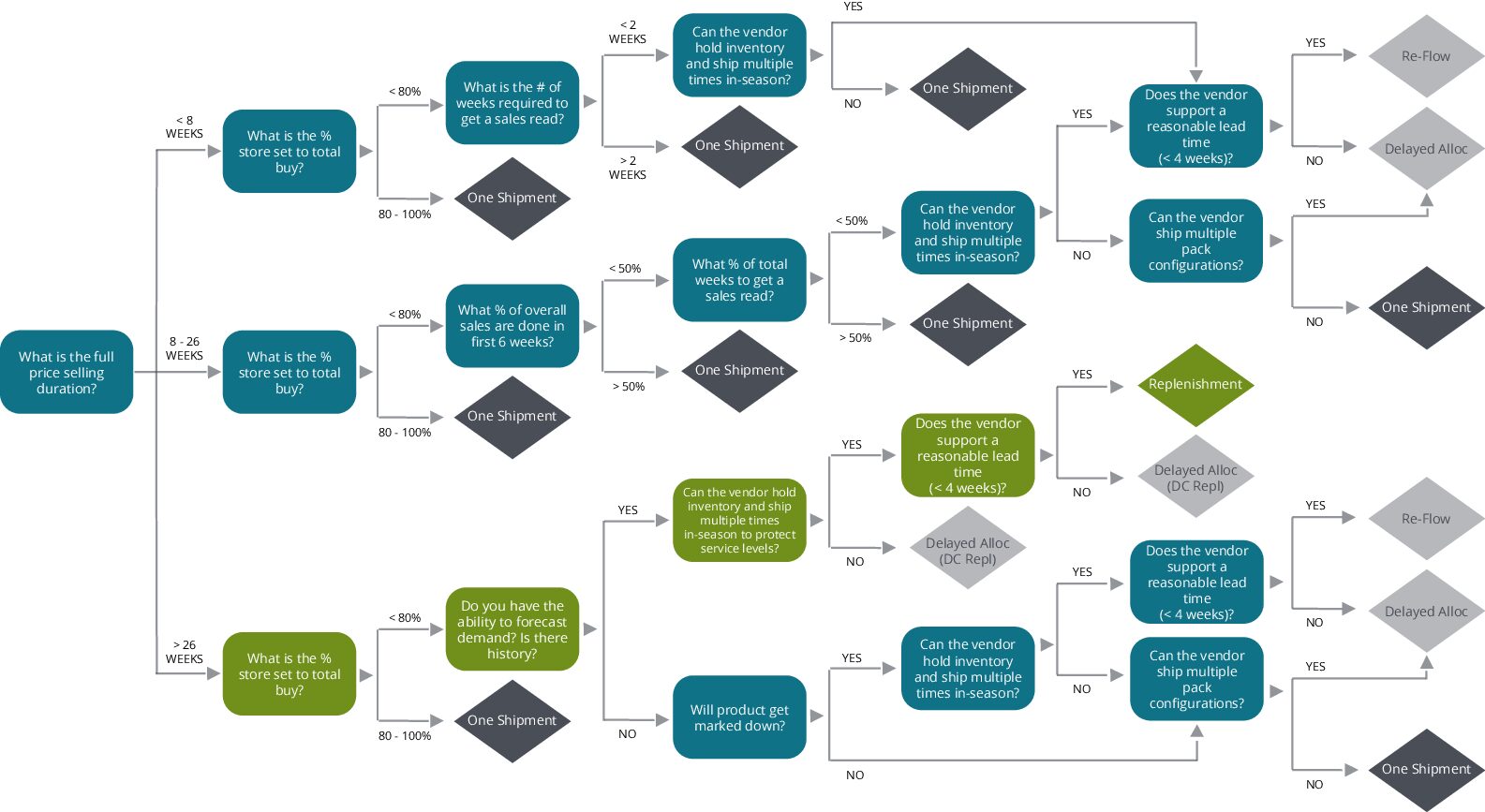
Moving through the decision tree will culminate in a decision to either use replenishment or one of the three allocation outcomes:

Allocate part of the initial order to stores and hold the balance in the DC to allocate later.

Spread the orders/shipments over time.

Distribute a single order 100% to stores at one time.
Allocation and Replenishment Decision Outcomes
While the inventory flow path is important to the fulfillment strategy, it is equally important to consider that critical rules and parameters apply to both allocation and replenishment, including such factors as vendor lead time, minimum order quantity, desired weeks of supply, safety stock, minimum presentation, and others. As these processes continue to evolve, many of the leading solution providers in this space approach fulfillment solutions as a unified process instead of the legacy approach of addressing them as individual functions. One critical component of this approach is the shift to incorporating more intelligent, forward-looking forecasts that leverage data and analytics to determine future demand needs.
What are allocation and replenishment leading practices?
As mentioned earlier, retail allocation and replenishment—along with other supply chain functions—were historically managed in silos. Leading practices are much more unified and collaborative than traditional or common practices.
Traditional Practices
- Separate business processes for allocation and replenishment are managed by separate teams
- Rules and parameters for each process are managed independently and may not align with the same goals
- Distinct systems require separate administration and technical support
- Historical data is used to calculate how much to purchase
- Each process supports a portion of the product’s lifecycle, e.g., where a product is in the lifecycle (new, mature, end-of-life) may have different approaches and goals depending on the process
Leading Practices
- Integrated solutions with a single demand signal leveraging an AI-based forecasting framework
- Demand and constraint implications are connected and visible across the entire supply chain
- Allocation and replenishment operate on the same platform using shared processing and data
- Focuses on product lifecycle management throughout the entire retail supply chain process
- Product lifecycle management is consolidated under a single business team and process
What common mistakes and challenges exist?
There are several common challenges and mistakes in retail allocation and replenishment. Many of these are driven by legacy business processes and antiquated systems.
Challenges
Without the benefit of a demand forecast that leading solutions provide, allocation and replenishment organizations rely on historical data and static formula-based need calculations.
Legacy allocation and replenishment solutions typically only consider actual sales, not total demand, which would compensate for lost sales due to out-of-stocks and substitutions.
Leading retail demand forecasting solutions will evaluate seasonality, promotions, and impacts of pricing and incorporate product attributes to aid in improving demand drivers, ultimately enhancing forecast accuracy.
An accurate prediction of demand is fundamental to effective distribution.
While a modern demand signal is critical to driving optimal decisions, this demand signal relies on accurate transactional history. Without controls and balances embedded in the ERP systems to identify imbalances, allocation and planning teams are at risk of making bad decisions and losing the credibility of their merchant partners.
Poorly managed master data including inconsistent descriptive information, outdated operational flags, limited product and location attributes, and no methodology for the archival of old products can also lead to erroneous decisions and impact efficiency.
The inability to see real-time product quantities at selling locations and distribution centers leads to poor allocation and replenishment decisions.
Retailers and consumer brands who do not share inventory across channels might be missing sales and overstocking their locations. Enabling this capability may require complex business rule engines in merchandising and order management solutions to support the business and optimize the order fulfillment process.
Forecasting demand becomes complicated in this scenario, as the location generating the demand often differs from the inventory source used to fulfill orders. It is important to understand how the business manages its omnichannel demand, and how those priorities and rules impact the allocation and replenishment systems and processes.
Mistakes
Examples of constraints include start-ship dates, product availability, warehouse capacity, storage capacity at retail stores, and supply chain lead times. These constraints can create overstocked and overflowing warehouses and storage areas, increased storage costs, missed business opportunities (i.e., when items arrive late), and increased labor costs.
In scenarios or environments where the item lifecycle is not considered, the product is often received too close to or after the intended promotion, holiday, peak selling period, end-of-life, etc.
This mistake goes back to the legacy allocation and replenishment approaches and systems. In many clients, we have seen that different, independent teams are devising the financial plan, creating the marketing strategy, building the assortment, purchasing products, and making allocation and replenishment decisions. This old way of working typically relies on a manual merchandise calendar which risks creating massive disconnects across the retailer’s supply chain.
In many cases, teams are so buried in plowing through their to-do list of time-sensitive execution tasks that they do not have the time or processes in place to review the effectiveness of fulfillment strategies in prior periods or seasons. The absence of hindsight may prevent picking up key changes or impacts to the business and often compounds issues that contribute to suboptimal inventory placement.
What is foundational to achieving more mature fulfillment capabilities?
True to any transformational effort, three foundational pillars in achieving allocation and replenishment maturity are people, processes, and data/systems. To successfully drive sustained transformational change in any of these pillars, retailers must also integrate a robust organizational change strategy as a key component in initiatives designed to advance their fulfillment capabilities.
People and roles
Reviewing and clearly defining roles and responsibilities is critical, as leading retailers are breaking down silos between allocation/replenishment and planning teams, and in some more forward-thinking organizations, including supply chain teams in this effort. This more collaborative environment does not have to be system-driven but can start with assessing and revising the communications and relationships between allocator/replenisher and buyer/planner roles.
Once clear roles and responsibilities are defined, it is important to develop additional skills that are required to support the new, more collaborative, and connected fulfillment environment. While traditional inventory management skills are still important, developing skills related to communication, forecasting, understanding promotional impacts, and more advanced analytics will be necessary to support the enhanced end-to-end fulfillment processes of tomorrow.
Processes
In a similar approach to reviewing and revising relationships and communications, the business processes around fulfillment and supply chain should be assessed to identify areas for moving toward more collaboration and end-to-end visibility. While breaking down some of these silos may be challenged by legacy system constraints, starting to understand exactly where roadblocks exist and outlining a roadmap toward more mature and efficient allocation and replenishment business processes can become the springboard for a retailer’s transformation in this area.
Data and Systems
It is critical to have a meaningful product hierarchy, robust product and location attributes, and data governance processes to maintain clean source data for the solutions. Further, retailers must have accurate and timely transactional data, including SKU/location demand data and real-time inventory.
Traceability of transactional data for internal systems combined with controls and balances during the ETL process to the software vendor’s solution is essential to ensure users’ reliability and provide the ability to resolve issues rapidly.
organizational Change
Changes to an organization, whether they stem from changed roles and responsibilities, revised processes, or new systems are inherently disruptive. A strategic organizational change approach and aligned communication plan address predictable organizational impacts and help retailers and consumer brands prioritize actions needed to proactively mitigate the negative effects of change including disengagement, discouragement, and fear. Additionally, including impacted stakeholders throughout transformation efforts provides transparency and visibility of changes and increases the adoption and sustainment of new ways of working.
What innovations can improve a company’s allocation and replenishment capabilities?
What are the key considerations when selecting and implementing a new allocation and replenishment system?
Selecting an allocation and replenishment system involves more than picking a new shiny tool. As part of the system selection, retailers must address old business processes and antiquated fulfillment roles and responsibilities. Without doing so, selecting and successfully implementing a new system will fall short of the expected benefits.
Specific considerations for selecting and implementing an allocation and replenishment system include:



You may also like