
Retail Digital Transformation
A Strategic Guide for Modern Retailers
Key Takeaways
- Retail digital transformation fails for organizational reasons, not technical ones — 70% of efforts miss their goals (McKinsey, BCG), and Bain puts the figure at 88%.
- Global digital transformation investment will approach $4 trillion by 2027 (IDC), yet results lag the spending.
- Five structural conditions — Organizational Alignment, Leadership Engagement, Communications, Learning & Development, and Sustainment — decide whether technology delivers durable results or becomes expensive shelfware.
- The five catalysts are sequenced by leverage, not project timeline. Remove one and the others degrade.
Retailers are not losing ground because they lack access to technology. They are losing ground because most transformation programs are not built to change how an organization actually works.
The National Retail Federation reports that retail technology has entered a phase defined by execution: scaling AI, connecting systems, and using data for faster, more reliable decisions. Salesforce’s 2025 Connected Shoppers research found that 86% of retailers have unified commerce initiatives underway, while 81% say inefficient processes and technology drain store associate productivity. The investment is not the problem.
The transformation track record is brutal regardless. McKinsey and BCG report that 70% of transformation efforts do not meet their goals; Bain’s 2024 analysis puts that figure at 88%. Global investment in digital transformation is projected to approach $4 trillion by 2027 (IDC). The money is moving. The results are not.
Five structural conditions determine whether a transformation produces durable business results or expensive shelfware. Every one of them is organizational. None of them is technical.
What is Retail Digital Transformation?
Retail digital transformation is the ongoing effort to modernize a retailer’s operating capabilities using better processes, cleaner data, stronger governance, and fit-for-purpose technology. The goal is to improve decisions, execution, customer experience, associate productivity, and financial performance.
It is different from digitization and digitalization. Digitization turns analog information into digital form. Digitalization uses digital tools to improve existing activities. Retail digital transformation goes further by rethinking how the enterprise operates across functions, channels, and roles.
That enterprise view is essential. A retailer cannot deliver a seamless omnichannel experience if inventory, product data, pricing, orders, labor, and customer information live in disconnected pockets. It also cannot scale artificial intelligence effectively if the underlying data is inconsistent, incomplete, or inaccessible.
Parker Avery’s retail data governance guidance makes this point directly: leading retailers treat data governance as a strategic business capability, and robust data is a prerequisite for advanced analytics, artificial intelligence, and omnichannel success.
Why is Retail Digital Transformation Urgent Now?
Customer expectations have outpaced many legacy operating models. Salesforce found that physical stores’ share of purchases is projected to decline from 45% in 2024 to 41% by 2026, while 49% of shoppers have abandoned purchases because of ordering friction. Operational gaps are now visible at the point of conversion.
Stores are carrying more operational weight than ever — serving simultaneously as fulfillment centers, experience hubs, and brand touchpoints while handling rising complexity with limited resources. AI is adding another layer of urgency: three out of four retailers in Salesforce’s research said AI agents will be vital to beating the competition within a year, and 76% are increasing AI investment over the next year.
None of this means retailers should chase every emerging tool. It means they need the operational discipline and organizational readiness to adopt the right tools, in the right sequence, with the right governance. That is a structural challenge, not a technical one.
The Structural Problem Most Retailers Underestimate
Most transformation programs are designed like projects: defined scope, a go-live date, a deployment team, and a training event. That model is adequate for operational change. It is structurally insufficient for transformation, which requires reinventing how an organization operates, shifting core beliefs, and building new behavioral norms.
The failure is rarely visible until it is expensive:
- One division adopts; another runs parallel workarounds that silently destroy downstream data integrity.
- Leaders approve the budget, attend the kickoff, and then disappear — and skepticism accumulates at the team level without ever surfacing in a status report.
- Planners and buyers revert to spreadsheet logic within two seasonal cycles because their directors were never formally equipped or made accountable for the new way of working.
The system generates the right recommendations. The organization has no structural reason to trust them. That is not a technology failure. It is an organizational one.
The Five Conditions for Successful Retail Digital Transformation
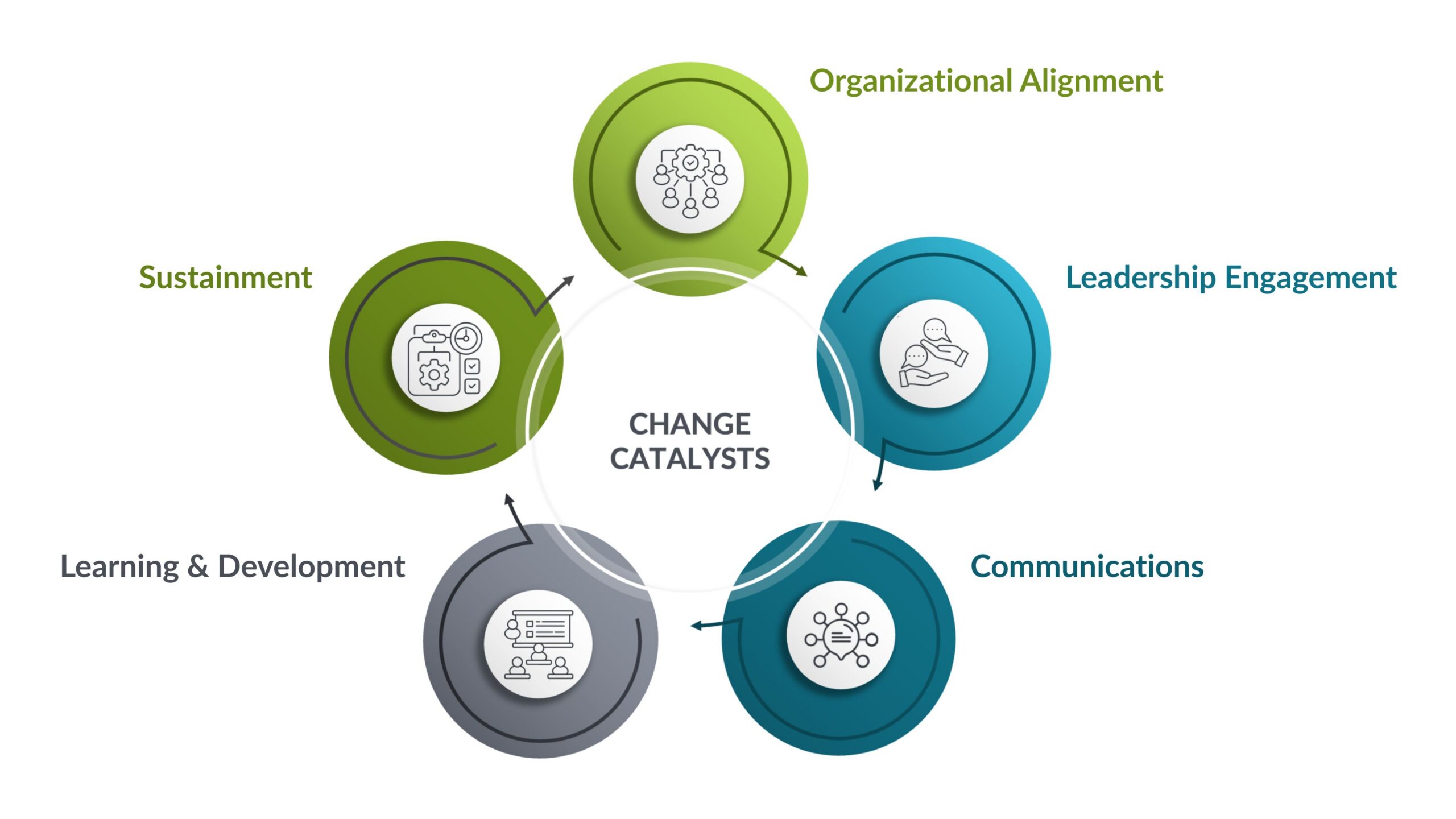
Parker Avery’s CAT5 Method™ is an organizational change framework built on Donella Meadows’ systems-thinking model. It identifies five catalysts — Organizational Alignment, Leadership Engagement, Communications, Learning & Development, and Sustainment — sequenced by leverage, not execution order. They are interdependent. Remove one, and the others degrade.
The sequencing is the insight most transformation programs never apply. Communications — which receives the most budget and attention in most change programs — is only the third most powerful lever. Without Alignment and Leadership functioning first, Communications produces polished messages that nobody internalizes. The investment is not wasted. It is premature.
Each catalyst creates a specific enabling condition. Without it, the transformation produces a predictable and expensive failure mode.
Organizational Alignment
Enables every function to pull toward the same definition of success. Without it, assortment strategies conflict, planning cycles disconnect, and decision rights blur. The business loss is not schedule slippage. It is margin erosion.
Leadership Engagement
Enables the organization to model, not just mandate, change. Visible leaders create permission structures that teams use to commit. Without them, skepticism accumulates quietly, the transformation target lowers to match actual behavior, and the reversal is expensive before it is even visible.
Communications
Enables consistent adoption across all functions and levels. Without it, one division changes, and others resort to workarounds. In a merchandising or master data rollout, that split does not produce unified commerce. It produces two systems running in parallel, and the data integrity of neither is guaranteed.
Learning & Development
Enables people to do the new work, not just know about it. The gap between being told to work differently and being able to do so is where goodwill turns to frustration. In merchandising, that gap manifests as in-stock failures, markdown exposure, and workarounds that calcify into the new normal.
Sustainment
Ensures the change outlasts the project. Without it, old behaviors reassert during the first seasonal crunch, and the investment leaves no institutional trace. System logins are not adoption. Changed decisions are.
Together, the five catalysts form a sequenced roadmap. Not a Gantt chart — a structural sequence. Alignment before Leadership. Leadership before Communications. Each condition creates the organizational surface area that allows the next to take hold.
What Leading Retailers Are Getting Right
The retailers making meaningful progress are not simply buying more technology. They are building the structural conditions that allow technology to produce results. They sequence the work: data infrastructure before AI, aligned decision rights before cross-functional rollout, organizational readiness assessed before go-live is scheduled. They treat the five catalysts as the implementation plan rather than a parallel workstream.
The retailers that protect their transformation investment are not the ones with the best technology strategy. They are the ones that built the five conditions that make technology work: aligned teams, visible leadership, consistent communications, real capability, and a change that outlasts the project team.
Is Your Organization Structurally Ready?
Understanding the five catalysts is the starting point. Knowing whether your transformation has the structural conditions in place to protect its investment is the harder question — and the more consequential one.
Parker Avery’s CAT5 Readiness Diagnostic maps each of the five CAT5 catalysts to a specific failure mode, a diagnostic question, and a checklist that determines whether your transformation is funded for a go-live or built to produce durable results. If you have already committed the budget, that is where to start.
Ready to assess where your retail digital transformation stands? Talk with The Parker Avery Group about building a practical roadmap that connects strategy, operations, data, technology, and the organizational adoption that determines whether it all actually works.
Retail Digital Transformation FAQs

You may also like